
The next durable source of AI advantage will not be owning the latest model. It will be building an organisation that captures context, connects decisions to outcomes and learns faster than its competitors can copy.
For the third book in what has somehow become a series, I wanted to address the question left sitting behind the first two: once the experiments, governance debates and executive declarations are over, what exactly should the organisation become?
The answer is not “an AI company”. That phrase is normally either meaningless or a warning that somebody has ordered new lanyards.
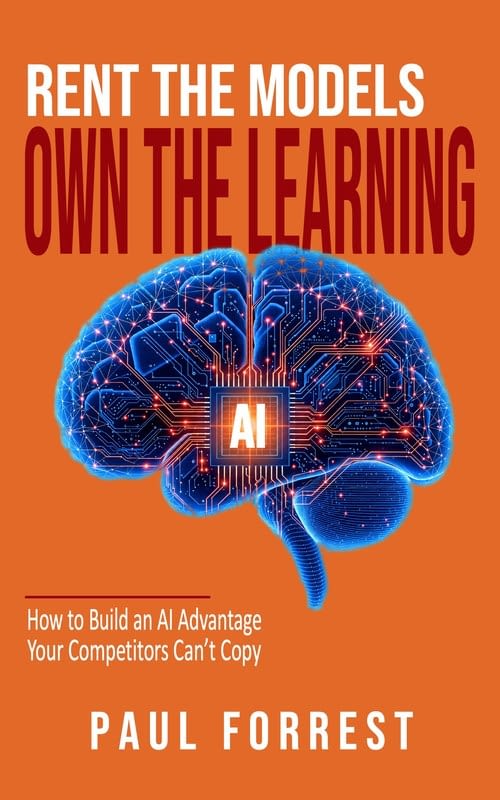
The useful answer is an organisation with a different target operating model: one designed to turn machine intelligence into better decisions, faster execution and proprietary learning. That is the argument at the centre of Rent the Models. Own the Learning.
What is an AI target operating model?
An AI target operating model defines how an organisation will combine people, proprietary context, workflows, decision rights, technology, controls and feedback to achieve outcomes it cannot achieve today. Its purpose is not to specify which model the business will buy. It is to make clear how the business will learn, act and improve when capable models are available to everyone.
Access to machine intelligence is becoming abundant. The same capabilities can be rented by you, your largest competitor and a determined person with a credit card. Access is valuable, but access alone is not differentiation.
If every competitor can rent the same cleverness, the strategic question moves elsewhere: what does your organisation know, learn and judge that its competitors do not—and can your systems use any of it?
Renting capability is sensible. Confusing it with strategy is not
Businesses should rent most general-purpose AI capability. Models improve rapidly, suppliers change and the cost of a given level of performance tends to fall. Pinning the enterprise to one supposedly unique model risks an expensive form of archaeology.
The durable asset is not the model. It is the organisation’s ability to evaluate models on its own work, switch suppliers without redesigning the business, and preserve the context and controls that sit above the technology.
Models become components with a price, latency, jurisdiction and measurable performance. The organisation owns the evaluation criteria, operating context, authority boundaries and learning loop. In plain English: rent the engine; own the vehicle, the route knowledge and the ability to tell whether you have arrived.
The real moat is a learning loop
Many firms speak about “proprietary data” as if possession itself creates advantage. It does not. A warehouse full of unlabelled documents is not a moat. It is storage with an unusually confident PowerPoint presentation.
Data becomes strategically useful when it supports a closed learning loop:
- A decision or action is recorded.
- The relevant context and assumptions are preserved.
- The outcome is observed.
- The outcome is connected back to the decision.
- The resulting lesson changes future behaviour.
The third and fourth steps are where most organisations quietly give up. They record what was produced, not why; activity, not consequence. Expert judgement remains in experienced heads until the expert retires, at which point the need becomes extremely clear and the timing mildly inconvenient.
Proprietary learning is different from proprietary data. Data is a stock; learning is the flow that makes it valuable. A competitor can buy a model tomorrow. It cannot buy four years of your organisation connecting actions to results, especially where the useful knowledge concerns exceptions and occasions when the standard answer was wrong.
That is the source of competitive differentiation: not artificial intelligence in isolation, but a system that allows the firm to become more accurate about the cases it actually encounters.
Design the operating model around an outcome, not a technology
The first question for a leadership team is disarmingly simple:
What are we trying to be able to do that we cannot do now?
The answer should fit in one sentence and contain no technology. “Issue standard quotations within four working hours” is an answer. “Deploy an enterprise agentic AI platform” is a shopping list wearing a strategy badge.
From that outcome, the target operating model must align six things:
- Source of value: what becomes cheaper, faster, safer, scarcer or harder to copy?
- Unit of work: are we improving a task, a workflow, a decision or a complete outcome?
- Role of people: who contributes judgement, handles exceptions and remains accountable?
- Architecture: can models be substituted without changing the business process?
- Governance: what may the system observe, recommend, execute, spend, disclose and change?
- Competitive logic: what accumulates here that another firm cannot simply purchase?
These questions cut across operations, technology, risk, finance and workforce design. An AI programme cannot solve them alone. Delivery and adoption have owners. What often has no owner is durability: whether today’s investment remains an advantage after the current model is superseded.
Durability needs an accountable executive who does not own the delivery date. Otherwise, long-term learning will repeatedly be traded for this quarter’s milestone—which is rational for the delivery team and disastrous for the enterprise.
The measurements that expose theatre
Adoption rates, licence counts and minutes “saved” can all be useful, but they do not show whether the organisation is learning. Three measures are more revealing:
- Feedback coverage: what proportion of consequential actions produce a recorded outcome?
- Feedback latency: how long does it take to observe that outcome?
- Learning velocity: how long from observing the outcome to changing behaviour?
Taken together, these numbers reveal whether the loop closes. A business with high AI adoption and negligible feedback coverage has not built a learning system. It has distributed software.
One further question is equally diagnostic: what are we collecting today that we were not collecting a year ago? If the honest answer is “nothing”, the programme may be improving personal productivity, but it is not yet building a proprietary organisational capability.
A practical first 90 days
The book proposes a bounded starting point. Choose one consequential decision the organisation makes often and imperfectly. Establish what people need to know to improve it. Define what must never be captured. Set authority and reversibility. Create a small acceptance set from the organisation’s own cases. Then run one learning loop on real work at low volume.
Before starting, write the stopping rule: what evidence would show that the next stage is not worth reaching? Perhaps the context cannot be collected affordably, the governance burden exceeds the value, or the supposed advantage is insufficiently distinctive.
Stopping can be the intelligent result. A recorded decision not to build is strategy. A three-year roadmap that nobody can stop is merely momentum with a logo.
Competitive differentiation is an organisational achievement
The companies creating durable value from AI will not necessarily own the largest models or announce the most pilots. They will know which outcomes matter, capture context around difficult decisions, govern machine authority and learn from results faster than rivals.
That is a target operating model question. It reaches into incentives, accountabilities, workflows, data, architecture, professional development and the economics of coordination. The technology matters enormously—but mainly because it makes weak operating disciplines fail faster and strong ones compound sooner.
Rent the Models. Own the Learning. is for boards, investors and executives who want to move beyond buying access to AI and start building an organisation that becomes harder to copy each time it works.
Buy Rent the Models. Own the Learning. on Amazon.
If your board or portfolio company is redesigning its operating model for AI—and would prefer an evidence-led route to another decorative transformation programme—contact Ecaveo.
#ArtificialIntelligence #AIStrategy #TargetOperatingModel #CompetitiveAdvantage #OrganisationalLearning